Sunday, February 16, 2014

Galapagos - the Enchanted Islands!

"Galapagos; the old Spanish word for tortoise; used by Bishop Tomas de Berlanga to name the islands"
"I'll never go on a cruise!"  Never say never.  Or my personal favorite: "It's a woman's prerogative to change her mind." If you want to experience the "Enchanted Isles", so named in the 1854 Herman Melville classic, there are basically three ways; land-based, water-based or a combination of both.  All have their pros and cons.
 All of the Galapagos Tours include a National Park-trained naturalist and many include round trip airfare.  

So many boats, so many itineraries, so many price differences: it's enough to make one consider staying home! 
But, how can you live in Ecuador for a year and not visit the UNESCO-declared and World Biosphere Reserve National Park?
Masked Boobie's nesting site.
After much research and probing conversations with others, we went on an jam-packed 8-day, water-based tour which visited 8 islands, islets and many surrounding coves.  
We decided on a 1st class Luxury Yacht with no more than 16 passengers and the most active itinerary available.  Each day we were guaranteed at least one snorkel outing and land-based trip.  We lucked out.  We had 3-4 outings daily and two guides! Some people opted out of a few day trips; most did all. 

Having zero experience with cruise ships of any type, never having been part of an organized tour longer than 3 hours - we were in new territory.  Could we adjust to 3 planned meals a day in which we had no say in the menu?  How would we fare being told to 'be up at this time' and 'be ready for a deep water snorkel ' at this time, dinner will be served 'at this time...?'.  Let me backtrack - this was no problem for many passengers - it was ME who was going to have to really 'go with the flow'. Yikes!  No say in the food?!  No control on meal time or outing times??  This must be what it's like to be my husband!
One of many wet landings off the dinghy
Posing Sea Lion.  We never saw more than 3 boats at one time; unless in port.
The people:  The demographic of the passengers seemed to reflect the boat's itinerary.  Singles and couples from Scotland, Norway, Holland, Switzerland, Nova Scotia and Toronto.  Four of us were originally from the States, but now, were all living and working in Quito.  Most of the passengers were in their upper 20's taking 3 month - or more- leaves from their jobs.  What is it with European travelers?  A vacation of 2 weeks is unheard of!  Many of them were scuba certified, all of them FUN.  Oh, and the 16 passenger thing?  We were 19. 
Squawking Masked Boobies - Espanola Island (Hood)
Look Dahlia - a black-headed swallow-tailed gull!!!
Christmas Marine Iguana - Lording over its beach
The Daily Drill (basically): Up at 6:00am for a sunrise on the top deck (opt); 7:00am brunch breakfast; 8:00am - off in the dinghy to snorkel and/or do a land-based hike. Back on the boat at 11:00; lunch at 12.
Crazy-cool lava formations!
It's so new it's still flowing!!

After lunch, a rest till 1:30; then pack up again for more off-boat adventure.
!!!!!!SNORKEL!!!!!!
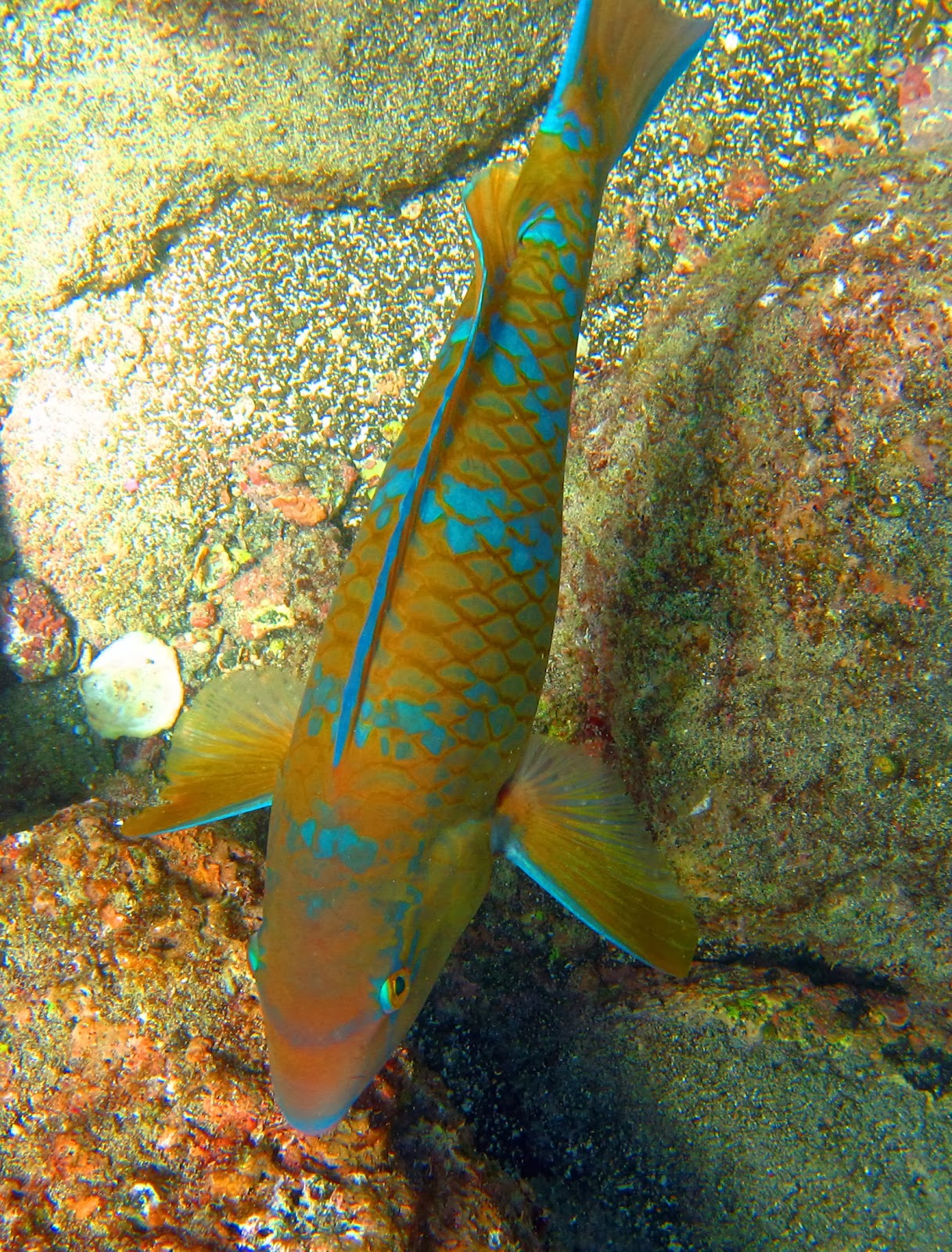
We snorkeled 12 times, from beach access to jumping out of the dinghy between the rock monoliths of Kicker Rock. Awesome! We swam with Galapagos sharks, white-tipped reef sharks - numbering more than 50 - hammerhead sharks, sea turtles, sea lions, school upon school of colorful fish, eagle rays, sting-rays, penguinos, sea stars that glowed... well, you get the idea.  An underwater paradise.

Tennis used a Canon S80 in a dedicated waterproof case on every snorkel. Taking shots of moving targets from a moving platform proved challenging.  (One of the guides made a 15 minute HD video using a GoPro camera.  If interested, using Google, go to YouTube and search for Galapagos G Adventure G7 Feb2014. It will be posted in my name.)

4:00pm - back on board for a hot shower & cocktails.  6:00 briefing for the next day's outings; 7:00 dinner - followed by top deck socializing and music~
Above:  Sandwiched between Scotland (l.) and Norway (r.)  
 Left:  Our guides and dinghy captain surprised everyone with their latin tunes!

The "guias"  A 28 yr old Galapagos native (l.) and a 54 yr old Ecuatoriano (r.) from Cuenca were our capable guides.  Again, all cruises must have at least one naturalist on board. They were knowledgeable, passionate about their islands and complemented each other extremely well.  Five days into the tour, I asked the elder guide how long they had been a team.  They seemed to work like a 'well-oiled' machine.  He glanced at his watch, hesitated and said, "five.......days!". Big laughs all around~
Colorful and ubiquitous - Sally Lightfoot crab
Brown Pelicans can scoop up 2 gallons of water at a time~
Reading "Floreana" by Margret Wittmer prior to the trip, made the stop at Post Office Bay a lot more fun.  Our group kept the tradition going. I left a few post cards and took some home to Quito to mail to others.  Let me me know if they arrive!
What comes to your mind when you think "First Class Luxury Yacht"?  Yeah, me too.  But on this trip, no one wore jewelry, no make-up, no fancy clothes.  Getting 'dressed for dinner' meant hoping a shirt you'd hand-washed and hung on the top deck was dry enough - and fresh-smelling enough - to sit at a shared table with others. It wasn't so much the 'cruise trip' I had imagined, but a backpack trip with a hot shower.  And we loved it!  The people, the landscapes, the shared experiences made it unforgettable.
At our first briefing, the guides encouraged us to let go of our 'mainland' routines, accept the rhythm of the islands, the movement of the sea, the pace of observing nature.  It was sound advice and when taken to heart, The Galapagos Islands are a thrill a minute.  
If you relish natural history, value stunning, dramatic landscapes, and appreciate political history, the Enchanted Isles are a magical place where one can observe the natural world as it was before man's impact. 

Truly, a trip of a lifetime!


Monday, January 13, 2014

Climbing Volcanoes - in the footsteps of Edward Whymper


Why are there streets & businesses in Quito named for this guy?
Who was Edward Whymper.....Whimper...?

"Born in London, a renowned climber in the Alps, Greenland and the Andes.  Whymper organized an expedition to Ecuador designed primarily to collect data for the study of altitude sickness and the effect of reduced pressure on the body.  (yup, altitude is definitely a factor).
In 1880, Whymper made two ascents of Chimborazo, also claiming the first ascent.  He spent a night on the summit of Cotopaxi and made first ascents of half a dozen other great volcanoes in the Andes."

We arrived in Ecuador in August 2013.  After living at sea level for over 35 years, it was quite a change!  Maintaining what could be called a fairly comprehensive fitness regimen our whole adult lives, we handled the adjustment to our new living conditions at 9,500 ft, better than most.

While many fellow teachers packed boxes of clothes, bedding, kitchen items, books and more; we filled 2 of our allotted 4 boxes with climbing gearice axes, crampons, climbing packs, climbing boots, pants, jackets, glove ‘systems’ harnesses, helmets, headlampsyou get the idea.  My husband agreed to accept another year of teaching – after 30 in the US – on the condition that we make climbing some of the major volcanoes a priority. 

Sorting gear before the Cotopaxi climb.(photo L)


Staging at the refuge for a 1:00am departure. (photo R)


Living in Guapulo fit right into our training program.  We continued our regular regimen of lifting/running/swimming in addition to the built-in ‘stairmaster; that’s unavoidable in Guapulo.  (see blog on Stairways to Heaven)


Rucu Pichincha – the good, the bad and sometimes the ugly.

The Good:  It’s close to Quito.  At 15,406 ft - it’s big.  It’s great peak to climb for training and altitude acclimatization.  Transportation access is relatively simple via bus &/or taxi to the Teleférico. It’s inexpensive to ride - with our work Visas - $4 each. The views of Quito, from the moment one exits the Teleférico throughout the ascent, are fantastic.  What a city at the base of the Andes!  It can be done in roughly 5 hours- rd trip- depending on the pace set.

The Bad: It is necessary to use the Teleférico to get to the trailhead.  The Teleférico does not begin operations before 9:00am.  This is BAD because the views from the top are lost around 11:00 EVERYDAY.  We’ve been observing the weather pattern on Pichincha for 6 months and note, with little exception, that the peak is shrouded in clouds by late morning.
Although it’s been a great day hike, a great training tool, a great city-escape, with the 9:00 start time, after 3 summits, we’ve yet to see the Avenue of the Volcanoes. 
The Ugly: Due to its close proximity to Quito, ease of access with the Teleférico, there are many users.  With users comes trail erosion and trash. (below: Once a Park Ranger; always a Park Ranger!)
Volcan Cotopaxi (19,997 ft)
There's a website called "mountain forecasts" which we used to monitor the weather regularly.  Trying to coordinate a climb with the time constraints of a teacher's work schedule is challenging.  In late September we found a weather window that was a dream;  clear skies, full moon and calm winds.  After living and training in Quito for 5 weeks, we made arrangements with the Ecuadorian Alpine Institute to climb Cotopaxi.  Ecuadorian Law requires one guide for every two climbers.  The service provides transportation, overnight access to the refuge - if there is one - food (more on that later), the equipment, knowledge and experience of the route. Our guided trip (one overnight) to Cotopaxi-whether you summit or not-was $200 each.  Normal rate was $240, but we had our own gear. For comparison sake: as of this writing, a guided trip up Mount Rainier with RMI costs one climber $1,006/person for the 'classic two-day climb" 
So while some would think our mandatory guide service was spendy, we knew otherwise.

The refugio for Cotopaxi is reached after a steep, sandy 800ft scramble from the parking lot.  Most guides use the speed with which their party attains the refuge to determine their departure time for the summit. 

Sleeping, and I use that term loosely-in a crowded
refuge with 35-40 fellow climbers has its challenges.
Perched at 15,953ft, you're breathing in some thin air. The other climbers fidget, cough, burp, fart, get up to use the bathroom.....sleep really isn't on the
agenda.  The bathroom at this refuge is located in an adjacent building (see photo R). Using the bathroom is a "tip-toe-crossing" of a long upper dorm room, a stairway descent-another long room crossing to the outside.  Using a headlamp, and stars if you're lucky, the unisex toilets have no toilet lids, no paper, no flushing capability.  After use, one dips a Clorox bottle into a barrel of water, pours it into the bowl and "voila!"  Yeah, baby, it flushes!
Our climb began at 1:30am and we were the last to leave the refuge.  Guess our guide was impressed with our speedy climb to the refuge the day before.  In our party:  two Ecuatoriano guides and 3 climbers. At 59, we were the oldest couple attempting Cotopaxi that morning. Our trekking poles were older than most of the other climbers!
It was glorious.  The lights of Quito and communities to the south twinkled in the distance throughout the climb.  Ramiro (lead guide) timed it perfectly.  For our efforts, we were treated to sunrise on the top with an incredible panoramic view at 6:30am on 26 September.
Statistically, we beat the odds.  Records for Cotopaxi state that 40% of those who attempt the summit are successful.  Mindful that getting to the top is only half way, we braced for the return. The descent was difficult. Glacier conditions were rough and there was little fresh snow on the mountain.  Down, down, down, we arrived at the refuge at 10:00am after an 8 1/2 hour 'marathon' of steady effort and full concentration.  Quite a day!
(Volcan Antisana was in full view for the descent)
FOOD - Guide services provide food for the climbs.  Dinner is prepared at the refuge, typically a pasta dish and served around 5:30-6:00pm.  Breakfast is served at 12:30am.  Sort of tough to choke it down at that hour. It can be granola with yogurt on top, lots of bananas, tea, coffee.  A 'snack/lunch' for the ascent is provided as well.  We found the snack to be poor fuel choices for our needs.  Also, it's quite to difficult to open individually wrapped candy bars, chips, crackers when one is perched on windy, exposed ridges -trying not to lose gloves- but needing them off to eat the snacks!

  For Volcan Nevado Cayambe, we learned our lesson and took pancake wraps with peanut butter and raisins and bean burrito wraps.  Open the foil cover and get complex carbos, protein and fat. Simple, efficient, important.  No Hammer Gel, or Gu here.
Volcan Nevado Cayambe (18,997ft)
Next in our sights was a mountain we see from our living room window almost every day:  Volcan Nevado Cayambe. Located northeast of Quito, it is the highest point on the equator with year round snow. How cool is that? Due to its proximity to the Amazon, it experiences the most severe weather of all the major Ecuadorian volcanoes. That part is not so cool. 
Statistically, the best months to climb Cayambe are December and January.  Back to "mountain forecasts" we went with guide service coordination with Ramiro, again from EAI.  
We had a guide we knew; a 'lucky' date 1/4/14;  and a lunch-stop sighting of a magnificent condor soaring above the hillside farms.
Surely Cayambe would smile on us for the climb as it did for our night at the refuge.(above/below)

We rested, waited and read while Ramiro cooked the pasta. 

 Wind gusts buffeting windows does not make for a gentle lullaby when you know what's ahead.  After interrupted sleep, we headed up Cayambe at 1:04am on 1/04/14.  No lie. Not planned, but I took it as another 'sign' of good fortune.  

With a mixture of ice pellets, crystal star-filled skies, soft snow, wind-whipped snow, more star-filled skies - we pressed on and hoped for the best.

(top; equipment adjustments; lower; a precious fluid break) Taking pictures in those weather conditions is extremely challenging.  Our gear was ice-covered from beginning to end.  Tennis had a plan to keep his camera close at hand and protected.  It wasn't sufficient for the conditions. Time on summit?  - about 2 minutes.(below)


In spite of these compromised pictures, the climb/descent was incredible.  The weather was a mixture of clear views, howling winds, double rainbows, brilliant stars, white-outs, ice walls, and steep 80M walls to ascend/descend with limited visibility.  "MOT" (mind on trail) was my mantra throughout. Focus, center, breathe.

I promised my husband I'd climb 2 big volcanoes with him while living here.  Promise made and kept.
In spite of what may look like  'terrible' conditions for a climb, it was an impactful, intense, unforgettably moving experience. 

We might just keep following in the footsteps of our friend, Edward Whymper....  Chimborazo, con permisowe've got our eyes on you!
(below; watching over his sheep on the road back to Quito


Saturday, January 4, 2014

Christmas in Cuenca - Why is this place considered THE ex-pat Capital?

Schools out!.....for the 2 week holiday break anyway- and we're off to see more of Ecuador.  Top on our list is Cuenca.  
Why has this location been voted - time and again - the #1 ex-pat/retirement destination in the Western Hemisphere? 
Let's find out~

This beautiful colonial city, dating from the 16th century was declared a Unesco World Heritage Site  - and for good reason. A city of roughly 500,000 located in the Southern Highlands, it is a destination in its own right, and the surrounding sites are another reason to make it more than a weekend get-away.  Read on:

Catedral Nueva -  with its striking blue-tiled domes, it is the signature cathedral in the historic town center.  It's the largest church in Latin America capable of seating 10,000 worshipers.  We were among them for a memorable Christmas Mass.

Parque de las FloresThe flower market is a daily event in the Plaza de San Francisco.  It attracts people like bees. The explosion of color and the variety of flowers never ceases to impress. Adjacent to this market is a Carmelite cloister where one can buy ''pítimas", a soothing drink concocted to cure depression and bring peace to your morning hurries.  The nuns also sell saints. You may purchase a saint to be displayed in your home and serve as protector for/from......we drank the Kool Aid and bought two saints. 
 Like to walk?  Cuenca considers itself a city of walkers
 and the Rio Tomebamba -one of 4 rivers that run through and around Cuenca - has pedestrian paths  for miles in either direction from the
historic center.  The paths are lit and filled with walkers, joggers throughout the day & evening.  During Christmas - the riverfront has seasonal lights that glow and reflect in the moving water - perfect for strolling after a dinner in one of the many restauants.  The river has many bridge crossings and homes along the cliff "Barranco" have been refurbished into galleries, restaurants, hostels and inns.
An artful dessert after a lively meal at Tiesto's, where the theme of "sharing meals with table mates" is robustly practiced!
The Jefferson Coliseo is a sports complex with a huge stadium, 6 hard court tennis courts, boxing gyms, wrestling rooms and a 10-lane Olympic distance swimming facility.  If you want athletic facilities open to the public - Cuenca has them. The TRI club was prepping for a Saturday morning workout.


What about public markets?  As 35+year residents of the Puget Sound area - we've enjoyed Seattle's Pikes Market on many occasions.  We love the sights, sounds, colors, aromas and excitement that a market atmosphere brings.  We visited the Feria Libre located near the Jefferson Coliseo. While we didn't see any fishmongers slinging fish, we also didn't see another person toting a camera.  This market is not frequented by ex-pats or tourists.  It's a working, bartering, resident and country-dwelling exchange market for Cuencanos.  Ethnic, colorful, gritty, real.  Slab of pork?

Ingapirca: Inca Ruins can be found in many South American locations, with the finest at Machu Picchu.  The best preserved Inca Ruins in Ecuador are at Ingapirca.  They are located about a 90 min drive NE of Cuenca - through gorgeous, green and  hilly countryside.  The ruins were originally used by the Cañarí as an observation post.  Since the Inca couldn't defeat them, they co-existed until the Spanish arrived in mid 1500's.  Most of the large smooth stones were used to build area churches. What remains makes for a very moving visit.

Parque Nacional Cajas: After pounding pavement in the city, and car touring to the north - we were ready to don our hiking boots and hit some trails. "Cajas" could mean 'box', a Spanish word describing the shape of some of the more than 250 crystal clear lakes. Or "Cajas" could be the Quicha word for 'cold'.  We chose to dress for the latter interpretation but were pleasantly surprised to hike all day in clear skies and temps in the upper 60's.  

With the trailhead base at 13,500ft, our route finding, scrambling and deep grass hiking was a workout with big rewards.  Set in the paramo (Andean highlands of grasses), we encountered several groups of llamas from a distance, but the few fellow hikers we saw stayed mostly along the roadside lake trail.  We had Cajas to ourselves. Like the signs says:  muy difícil~

El Pase del Nino Viajero:
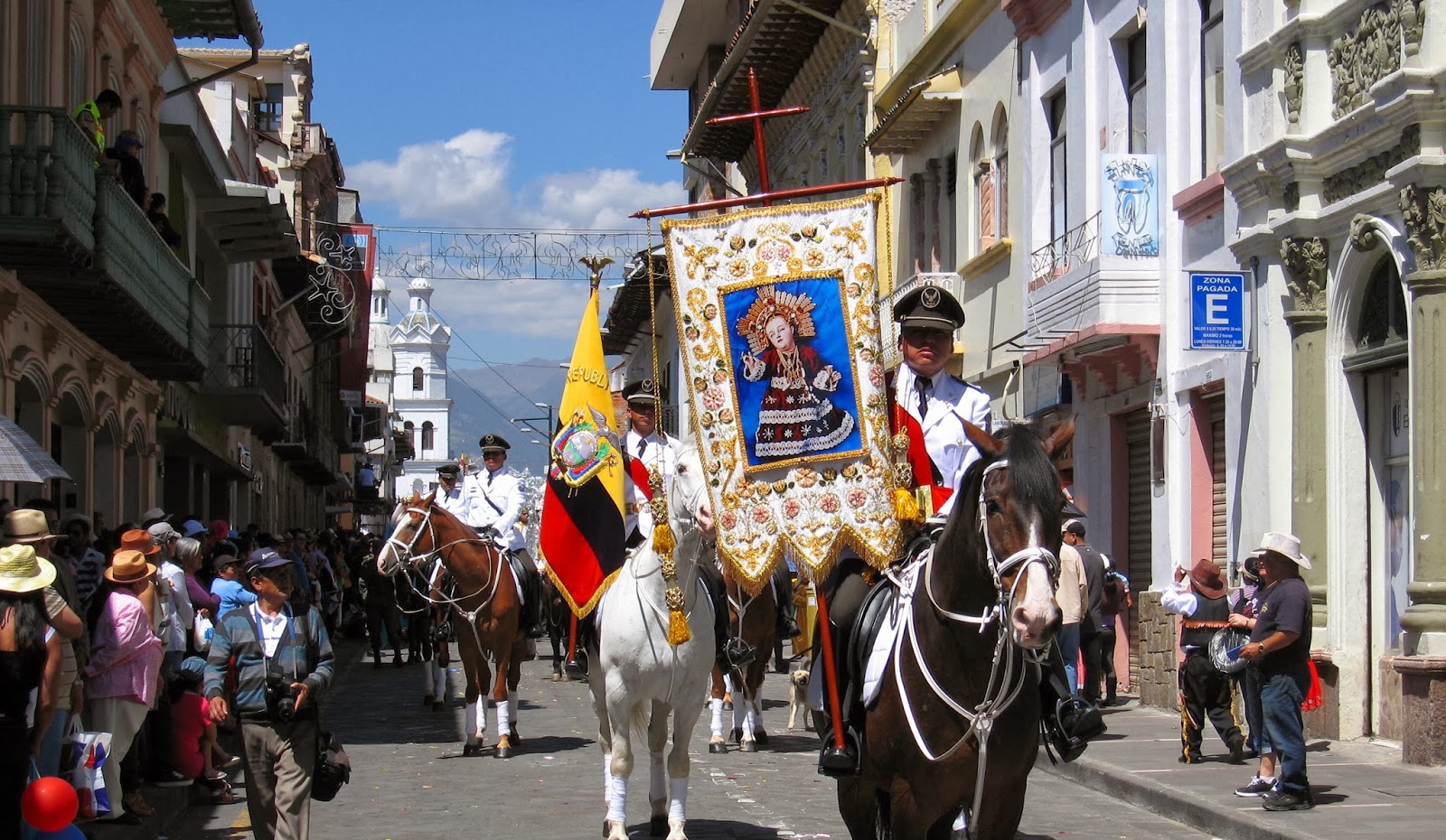
Photos and script are sorely inadaquate when trying to convey the phenomenal parade and event called the El Pase del Nino Viajero. Little did we know, when we made our October plans to spend 10 days in Cuenca for the Christmas holiday, that we would be witnessing the country's most important display of 'religiosity'.  And, by just happenstance, our apartment was on the parade route!  
 We heard the bands playing, the drums sounding, felt the excitement building at 9:00am - our hearts were pounding too! 


Elaborate costumes and the children/ninos - were the stars of the show!  Horses decorated with saddle blankets loaded with farm produce in artistic display.  Cooked pork, cuy, chicken, arranged on platters and paraded through the cobbled streets. Any vehicles in the parade were covered in cloths to minimize their mechanical impact - 
The view from one of our buildings four balconies shows the length and width of this parade which lasted from 9:00am - 6:00pm.  Nonstop music, dancers, floats, people, horses, and revelry!  An experience any spectator will never forget.
While we like the activity the city has to offer, we are also drawn to the countryside.  So, using public buses, we used our last day in Cuenca to visit the pueblo of Girón - whose 'claim to fame' is a lovely drive-to waterfall.  While there we learned there is another - more dramatic waterfall through farmers' pastures and we struck out for it.  Once again, the effort pays off.


Cuenca is a very special place and it's pretty easy to see the attraction for ex-pats from the USA, Canada, UK, Australia, France...Its lively art scene, walk able historic city, university, athletic facilities, restaurants - ethnic and continental, temperate climate, gorgeous setting....alot to like!
We stayed in a VRBO owned by an Anchorage couple. Their property manager greeted us upon arrival, stocked the fridge with items I requested,  put us in contact with a bilingual driver  who was at our disposal throughout our 10-day stay.  What does a 950 sq ft modern apartment in the heart of the colonial city go for? A unit like I briefly described sells for $60-80,000 with yearly taxes of around $100.  That's not a misprint.
I don't pretend to know how Ecuador maintains its public facilities or roads or libraries or schools - but the real-estate tax can't make much of a dent.
Cuenca is an Ecuadorian city not to be missed!